


Overview
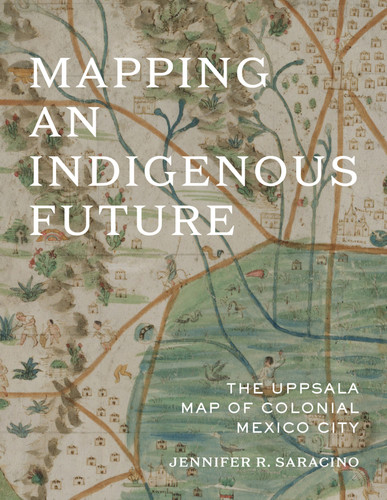
Rediscovered in a Swedish library in the 1800s, the Uppsala Map of colonial Mexico City is a crucial Indigenous-authored document. Nearly a square meter, it was created by Nahua artists in 1540 shortly after the Spanish invasion. The Franciscan-trained artists have long been characterized as having passively adopted European aesthetics in their representation.
Jennifer Saracino challenges this view, arguing that the artists purposefully blended both Nahua and European visual strategies to legitimize and improve their position in colonial society. Building upon archival, ethnohistorical, and archaeological research, Saracino reinterprets the map’s network of roads and waterways, agricultural and urban features, glyphs, and depictions of Nahua people. Saracino argues that, amid dispossession and exploitation, the artists made a visual case for Nahuas to steward the local population and land in collaboration with colonial officials as privileged intermediaries. Challenging the assumption that the map was made merely in service to the crown, Mapping an Indigenous Future contends that these Nahua mapmakers capitalized on their proximity to viceregal elites to appeal for their rightful role as custodians of New Spain.
While major retailers like Amazon may carry Mapping an Indigenous Future (The Uppsala Map of Colonial Mexico City), we specialize in bulk book sales and offer personalized service from our friendly, book-smart team based in Portland, Oregon. We’re proud to offer a Price Match Guarantee and a streamlined ordering experience from people who truly care.
We’re trusted by over 75,000 customers, many of whom return time and again. Want proof? Just check out our 25,000+ customer reviews—real feedback from people who love how we do business.
Prefer to talk to a real person? Our Book Specialists are here Monday–Friday, 8 a.m. to 5 p.m. PST and ready to help with your bulk order of Mapping an Indigenous Future (The Uppsala Map of Colonial Mexico City).